


“Bank for the Moment” Replaces “Banked for Life”
In a constantly shifting financial landscape, attracting and winning primacy has never been more vital—or more elusive. Since the dawn of the banking industry, banks could confidently rely on consumers’ hesitance to change banks. For decades, approximately 40% of customers would choose a local bank, then stay with that bank for the length of their lives. Unfortunately for banks, this old-hat concept of blind loyalty is incomprehensible to today’s consumer.
When loyalty was near guaranteed, it made sense for banks to invest heavily in new customer acquisition. Banking digital ad-spending in the U.S. alone is forecast to hit $17B in 2024. Yet that investment only gets a customer through the door. Banks have been spending themselves nearly into unprofitability to compete for a shot at primacy for the same customers time and time again.
It is time for banks to shift their focus beyond traditional acquisition efforts. Consumers’ abandonment of loyalty for a “bank for the moment” mindset has upgraded banks’ personalization ambitions from roadmap wish list to urgent priority. The next decade of finance will be driven by fickle consumers whose “always be shopping” approach toward financial products is characterized by continual evaluation of available terms, incentives, and rewards in pursuit of those that best advantage their evolving needs and life stages.
Banks have historically focused on branch networks to meet consumers’ need for convenient access. But proximity is no longer the exclusive driver for banking decisions. Consumers are now comfortable managing the majority of their financial services online—many even prefer to. So is it still possible for one bank to meet all of a customer’s needs? Each consumer’s financial needs continuously evolve as they age and life grows more complex. Yet for financial institutions, aspiring to prime bank status remains the most realistic—and most profitable—objective.
Banking Challenges: Rising Expectations, Declining Loyalty
The longstanding assumption that consumers prefer to do all their banking with one bank has officially been debunked. The modern consumer is happy to manage the complexity of multiple banking relationships to extract best-of-breed value for each distinct need. Over the last decade, the rapid growth of digital banking and enhanced fintech offerings have led consumers to expect more from their financial institutions. Today’s consumers—especially younger generations—are always shopping for a better product, price, or experience. As a result, bank switching is on the rise.
A full 55% of consumers under 27 have already switched banks “once or twice,” shattering the banked-for-life status quo. Consumers now measure their banks’ digital delivery against the practices of world-class online retailers. Fair or not, the Amazon effect has spread to financial services. Frictionless experiences, personalized services, and transparent product comparisons have shifted from innovation wish list to table stakes.
Source: 2024 BAI Banking Outlook
The Amazon Effect and the Banking Experience
Establishing primacy has always been key to bank profitability. Historically, overdraft fees and other non-interest income represented a significant portion of bank earnings. Proposed federal regulations, however, will severely curtail banks’ ability to benefit from traditional fees. Without them, under-engaged customers will no longer generate enough revenue to cover the costs of onboarding and account management. Capturing the lion’s share of a customer’s assets is more critical than ever.
More than half of all customers could be swayed to switch banks. A full 56% report that finding better products and services at a different bank would make them consider switching. Services like deposit-switching represent one such inducement—but on their own they are not always enough.
Consolidation Is No Longer King
Among banking consumers, we’ve seen an attitudinal shift. The coveted emerging affluent are routinely hopping from bank to bank in search of better terms. Across all generations, primacy has become a moving target—but Gen Z and Millennial consumers stand out for rejecting loyalty as a concept across their purchasing behavior, embracing the “bank for the moment” mindset.
6 in 10 Gen Z consumers are willing to switch financial services organizations in favor of a bank that offers better mobile banking via app and other digital capabilities. 54% of Millennials and 34% of Gen X would also make the switch.
Finding the Profitability Unlock
Desperately seeking deposits, banks resort to outsized offers—anything from $400 to $1,000 for setting up a savings account. Yet activation rates are a dismal 60% industry-wide, and many activated accounts remain under-engaged and unprofitable. The most effective growth strategies now focus more narrowly on driving the specific customer behaviors that signal loyalty and impact profitability.
Accelerating loyalty behaviors by optimizing onboarding is what a recent Javelin study describes as the “next frontier in building profitable primary financial institution (PFI) relationships.” Primacy is typically achieved in the first 90 days, yet most activated accounts never reach this milestone. The single largest factor signaling primacy is direct deposit enrollment. Customers who switch their direct deposit carry larger balances and generate more transaction revenue than those who don’t.
More than 93% of people get their paychecks via direct deposit—with paper checks a distant second at just 3.6%. This means just about every employee in America is paid via direct deposit.
Source: American Payroll Association (APA), “Getting Paid in America.”
The financial institution that wins a customer’s direct deposit enrollment earns, on average, an additional $608 in non-interest income per year. Direct-deposit-enrolled customers generate 551% more revenue than non-enrolled customers. The customer has not been won until their direct deposit has been captured.
Source: Pinwheel 2024 Benchmarking Study—composed from publicly available information from 2,308 US Traditional Financial Institutions with over $500M+ in assets and a focus in consumer banking. Direct-deposit-enrolled accounts generate $784/year in non-interest income vs. $120 for non-enrolled.
The Next Battlefield for Primacy
For banks to unlock profitability, they must continually defend primacy—effectively reacquiring the customer throughout the relationship. Javelin recommends “ongoing onboarding,” a process of continuous engagement over the customer lifecycle.
For customers, defining primacy is no longer straightforward. While direct deposit is the cornerstone of primacy, it’s not the sole component. Young consumers consider the account from which they pay their bills even more important than the account that holds their direct deposit. This necessitates that banks invest in improving the bill-switching process during onboarding—long considered a burdensome chore.
Consumers have long complained about the friction of transitioning recurring payments to a new account. In a 2024 Pinwheel study, consumers ranked “the hassle of changing recurring payments” among the top 3 reasons they fear switching banks. Yet not a single one of the top 30 banks has invested in technology to simplify this process—a gap that, given the business case for satisfaction and share of wallet, strikes us as irrational.
Securing recurring payments at the onset of a customer relationship accelerates primacy in multiple ways. When banks:
- Win recurring payments like mortgage or rent, they reach a sticky and significant transition milestone that leads to greater share of wallet
- Deliver a leading-edge bill payment switching experience, it serves as a tremendous differentiator among their competitive set
- Offer a convenient way to switch and monitor recurring payments, they improve customers’ financial lives and inspire intent for primacy
Learn more about how ELGA Credit Union is building an end-to-end primacy program powered by Pinwheel here.
The Solution: Meaningful Personalization Drives Primacy
In the coming years, banks will need primacy strategies that deliver next-generation personalization to stay ahead of customers’ needs. A frictionless customer experience will be the cost of entry. Additional investments in machine learning, third-party data integration, and new data use cases are required to ensure in-house products claim the first look when customers’ financial needs expand or change.
Today, a disconnect exists between personalization best practices and how “personalized offers” are actually implemented. Most banks prioritize cross-sell campaigns to the segments that make them the most money—targeted, not personalized. Leading with offer profitability over offer relevance may even yield the opposite of the intended effect, turning off the high-value customers being targeted.
Leading-edge banks will shift to AI-enabled analytics to predict customers’ evolving needs across the lifecycle, cross-selling products like children’s accounts, CDs, or mortgages at the appropriate life-stage juncture rather than whichever product is most profitable. 55% of consumers say they do not get their auto loan, mortgage, credit cards, and brokerage services from the same bank that holds their primary checking account relationship. Tailoring offers to the customer’s financial life stage helps keep these accounts in-house.
Conclusion
The future of finance rests upon an optimized digital customer experience, which plays an ever more prominent role in the decisions of each new generation. The modern consumer shows little hesitation to level up as soon as their bank falls behind, so the urgency to innovate is mission-critical. Intuitive design, frictionless experiences, and open banking integrations that improve consumers’ financial lives are the pathways to engagement, loyalty, and LTV. So where to begin?
Pinwheel PreMatch & Verify
Pinwheel’s PreMatch feature can be easily integrated into the bank account opening workflow to identify and sync a new customer’s payroll data based on their application data. Rich historical, current, and predictive income insights let you know your customer better on day one, enabling precision offers from the start of the relationship. Pinwheel’s Verify product streamlines credit application and decisioning with just-in-time, paperless income and employment verification.
Grow revenue with income-based personalized offers:
- Offer financial products based on actual income, not only stated income
- Eliminate instances of income fraud by connecting directly to payroll providers
- Reduce underwriting and verification overhead by automating retrieval of W2s and pay stubs
Benefits of digitizing income and employment verification:
Visit our Personalization Solutions page to understand how Pinwheel can help you progress your primacy roadmap.
Pinwheel Deposit Switch
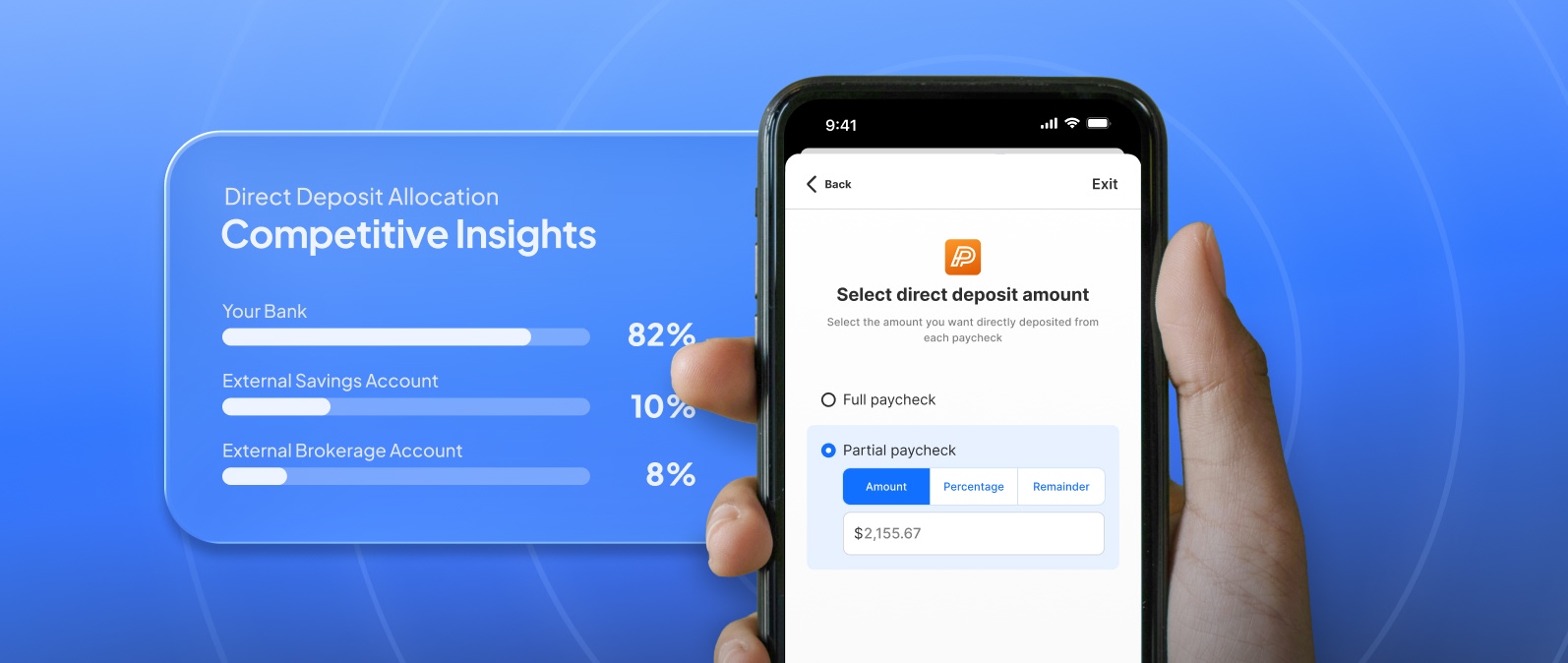
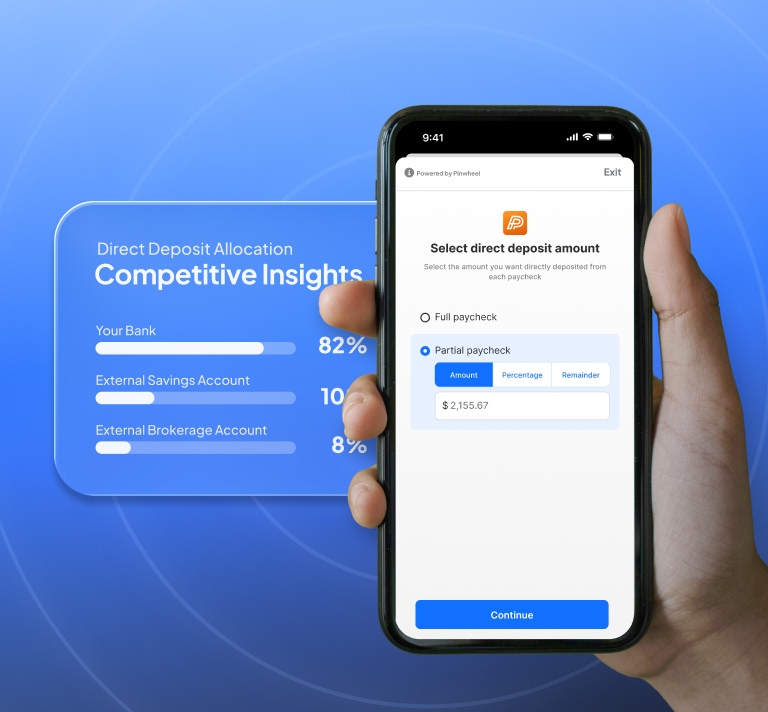
A frictionless deposit switch experience is a customer delighter that helps banks grow early-tenure deposits and accelerate primacy when integrated seamlessly with onboarding. Pinwheel Deposit Switch, the industry’s top-converting deposit switch solution, proactively surfaces identified active payroll records and can facilitate an instant switch in just two clicks.
Benefits of digitizing income and employment verification:
Pinwheel’s bill switching solution can be implemented together with deposit switching for a fully optimized account activation experience. Pinwheel ‘Switch Kit’ is a quick-to-market option for financial institutions looking to boost activation rates of digital acquisitions. Capturing recurring bills in the critical first 45 days of the customer lifecycle drives incremental uplift to direct deposit enrollments and further cements primacy.
50% of banks are planning to implement an automated direct deposit solution within the next 12–18 months.
Source: Survey of Consumer Bankers’ Association Deposits & Payments Committee members.
The Untapped Opportunity to Grow Direct Deposit
A frictionless deposit switch experience is a customer delighter that helps banks grow early-tenure deposits and accelerate primacy when integrated seamlessly with onboarding. Pinwheel Deposit Switch, the ind
To learn more about how Pinwheel can partner with you to grow deposits and drive primacy by combining unique income data insights with frictionless activation and engagement solutions, contact us →