


What is a personal finance agent?
A personal finance agent is an AI assistant that manages money on a consumer’s behalf. It goes beyond answering questions to take actions, such as adjusting a paycheck split or gathering tax forms. Agents are already unburdening consumers from the friction of scheduling, reservations, reminders, and travel planning. Personal finance is next.
Why can’t expense-tracking agents improve financial outcomes?
An agent that only analyzes expenses is working downstream of the most important parts of a household budget. By the time money lands in an account and a credit card gets paid, the decisions that shape a person’s wealth have already been made inside their payroll account: tax withholding, HSA and FSA contributions, 401(k) deferrals, and how net pay is split across checking, savings, and investment accounts.
To change outcomes, an agent needs verified payroll data, a comprehensive view of allocations, and the ability to act on them.
What is consumer-permissioned payroll access?
Consumer-permissioned access means a consumer explicitly authorizes an application or agent to retrieve their data or make changes on their behalf, and can revoke that access at any time. Pinwheel is a payroll connectivity API that gives AI agents this access to the layer that matters. With a user’s permission, an agent can read verified income directly from payroll, compare it against investment goals, and change how a paycheck is distributed. It can also retrieve tax forms and file taxes on the user’s behalf.
Pinwheel acts as the action layer: AI agents can execute changes to improve financial outcomes on the consumer’s behalf. That’s a much more valuable use case than just reporting where money went.
What can an AI agent do with Pinwheel?
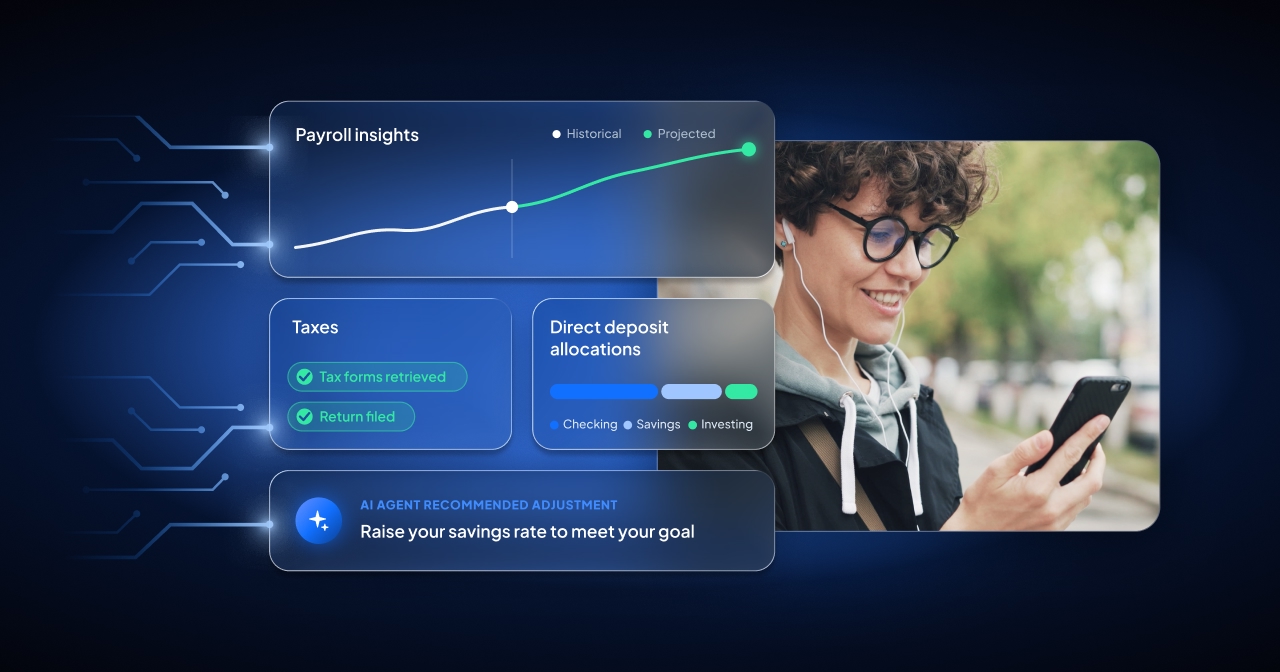
Payroll insights: “How am I doing?”
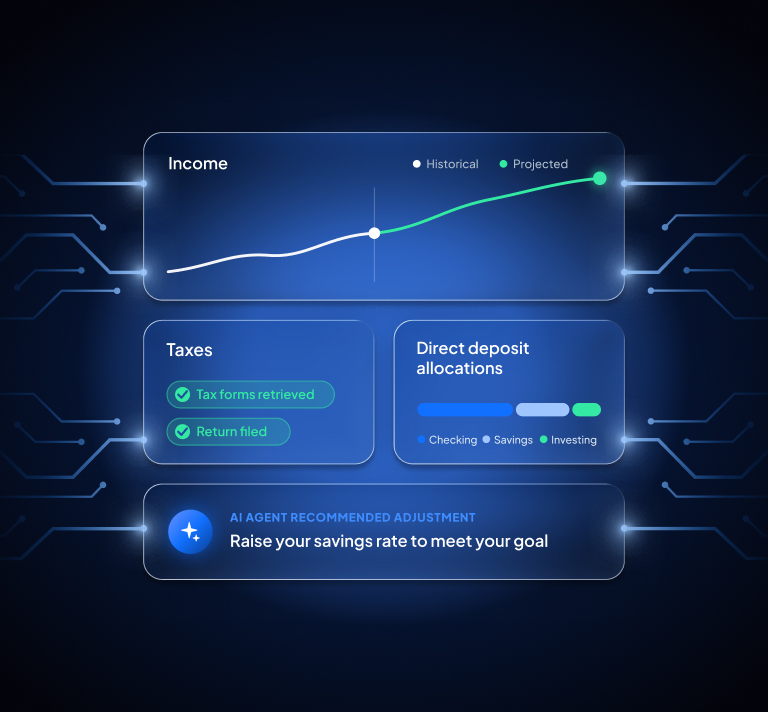
Earlier in my career at BlackRock, I learned that the most common question consumers asked their financial advisor was “how am I doing?” Pinwheel payroll insights let agents answer it with verified data. An agent can compare historical and projected income, savings rates, and investment rates against peers, then recommend the adjustments needed to meet a goal.
Direct deposit allocations: optimize how each paycheck is split
With Pinwheel, an agent can instantly make approved changes to how each paycheck is divided across accounts. The consumer no longer needs to visit separate employer, payroll, benefit provider, and wealth management sites to make the switch.
Explore Pinwheel's Direct Deposit product →
Taxes: from sharing tax forms to filing a return
Many situations require submitting tax forms, including applying for a lease, buying a car, or getting a loan. Pinwheel lets agents retrieve a consumer’s tax documents, and can support end-to-end tax preparation and filing, so a chatbot can carry the load.
Explore Pinwheel's Tax product →
Earned Wage Access: covering cash flow shortfalls
Earned Wage Access (EWA) lets workers access wages they have already earned before payday. It matters because just 30% of Americans have savings to cover a $1,000 emergency expense, according to Bankrate. Pinwheel will ultimately enable personal finance agents to spot an upcoming cash flow shortfall and secure EWA from across a user’s financial providers.
What do AI labs and financial platforms need from a data and action partner?
For AI labs and financial platforms building personal financial management (PFM) tools, the hard problem is not imagining the possibilities. It is finding data and action partners whose solutions are:
- Consumer-permissioned: must have built-in controls to securely identify and authorize user permission for each connection.
- Auditable: every read and write job must be logged for real-time and retroactive QA.
- Compliant: engaging with PII and financial transactions requires 100% compliance with governing regulations in each market.
- Fraud-resistant: realistically solutions should be exceeding current security mandates to ensure next generation consumer protections are proactively in place for agentic use cases.
Trust is the foundation of agentic finance
As a 20-year financial services veteran, I expect AI adoption to be the most radical leap forward in consumer behavior that I will see during my lifetime. But a functioning financial ecosystem must be built on trust, and that tenet will never change.
As AI labs build trust with consumers, demand for more sophisticated financial management will quickly follow. Security, consumer protection, and customer-first design have always been core to Pinwheel’s ethos. I’m honored to be part of the team at Pinwheel working to deliver the future of agentic banking.