
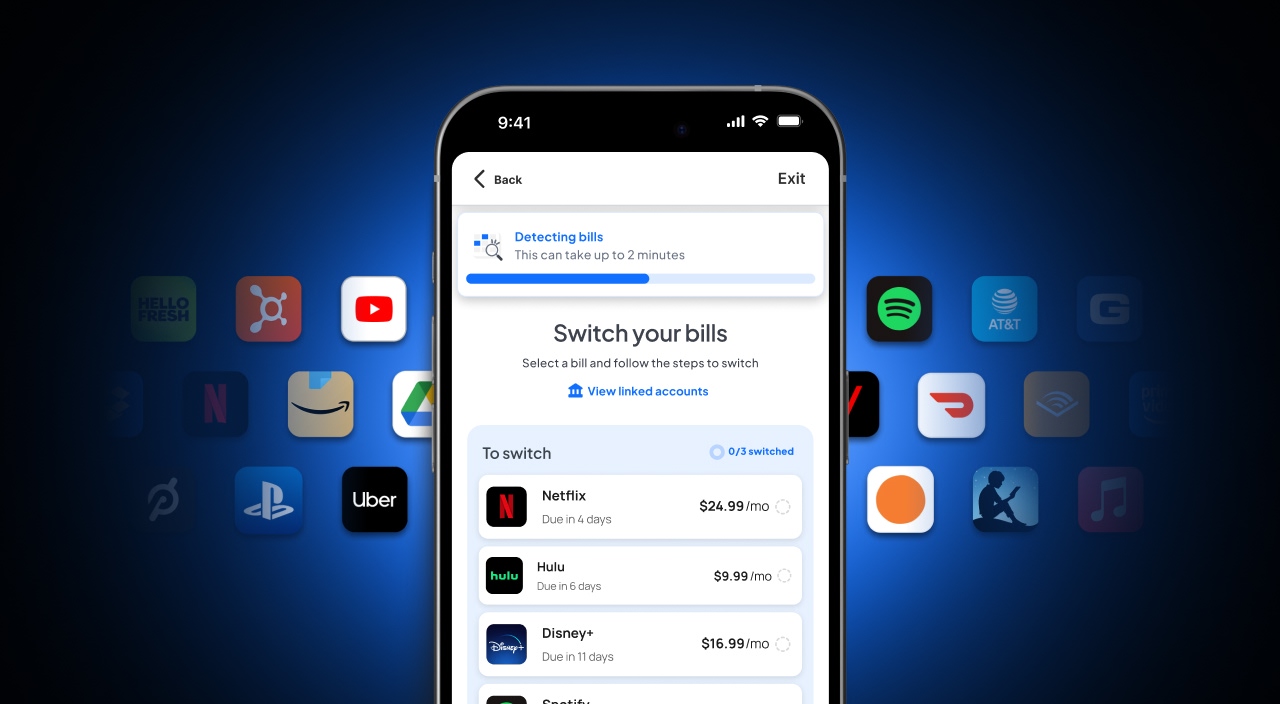
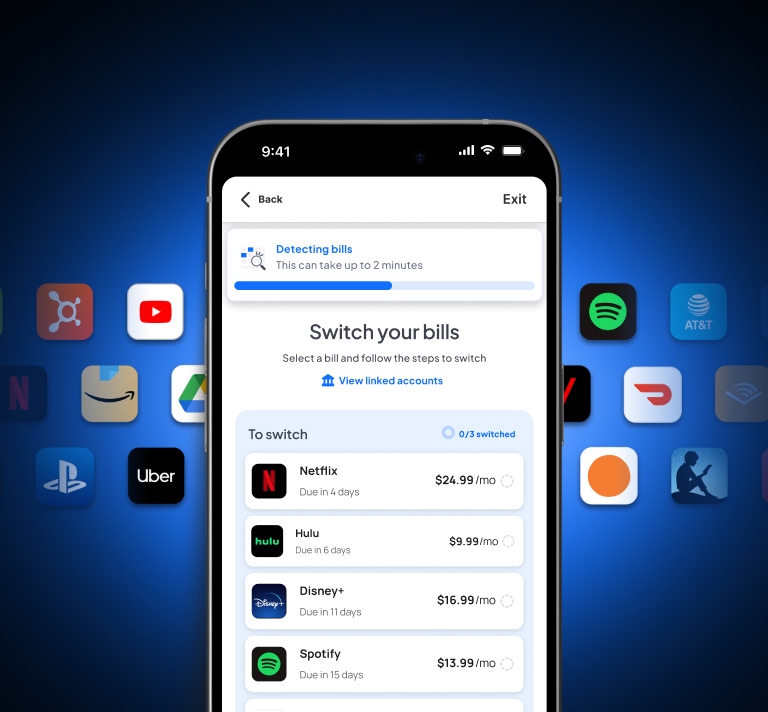


Bill payment switch is a digital banking feature that helps a customer move recurring payments (subscriptions, utilities, memberships) from an old bank account or card to a new account at your institution. Banks and credit unions are increasingly offering within their onboarding flow to secure account primacy.
This article summarizes best practices for evaluating and launching a bill payment switch experience.
How bill payment switch works
Advanced bill switching vendor solutions incorporate 5 key procedural steps and are available to deploy from within your digital banking app.
- Connect pay from accounts or merchants. In some products the customer connects the checking account or credit card they currently pay bills from; in others they sign in directly to each merchant.
- Detect recurring payments. The vendor scans transaction history and surfaces recurring payments automatically, so the customer does not have to remember every subscription.
- Select what to move. The customer reviews a checklist or dashboard of detected bills and chooses which ones to point at the new account. Some flows let them pick when each switch takes effect around due dates.
- Update the payment method. Where the biller is integrated, the vendor updates the ACH or card-on-file details directly. Where it is not, the customer gets step-by-step instructions plus copy-and-paste account details.
- Confirm and track. Each switch reports back with a status, so the customer knows which bills moved and which still need attention.
Capturing recurring payments drives primacy
Recurring payments keep customers tied to legacy bank accounts. Consumers have consistently cited the perceived burden of switching and/or missing recurring bill payments as their top reason for not switching to a bank that better meets their needs. Mastercard frames the problem plainly: recurring payments can tether customers to their old banks, preventing newly acquired accounts from converting to primary accounts.
The business case for investing in a payment switch vendor rests on four outcomes:
- Core deposits. Capturing recurring payment flows, and payroll when paired with direct deposit switching, keeps balances in your institution. Pinwheel positions this as a way to increase deposit volume.
- Retention. An account that pays the mortgage, the phone bill, and streaming services is harder to leave than one that holds a sign-up bonus.
- Activation. New accounts that are used for daily transactional spending become full relationships rather than sparsely used secondary / back-up accounts.
- Lower friction at switching. Customers often stay put because updating each biller by hand is tedious. Removing that effort, while maintaining customers within your app experience, is the point of investing in a bill pay switch solution.
The industry has been attempting to address this problem since 2006 when Yodlee launched its bill pay switching kit. Early evidence from Pinwheel’s Bill Switch product launch for Varo Bank show that 40% of users who linked external accounts and had recurring bills identified went on to switch at least one bill.
Helpful tips for evaluating a payment switch vendor
Biller coverage for your customer profile and the implied share of switches that a user can complete without leaving your app are paramount considerations for success. The table below can be useful as a due-diligence checklist for payment switch vendors.
Bill payment switch vendors compared: Mastercard, Knot, Pinwheel
ACH-funded bills. Many recurring bills (utilities, insurance, loans) are paid by ACH rather than card, so ask every vendor which payment methods it can switch. Mastercard and Pinwheel both describe switching ACH as well as card-on-file payments. Knot's public documentation describes switching saved credit and debit cards and does not describe ACH bill payment switching, so confirm ACH coverage with Knot directly if it matters to your customers.
Yodlee was an early entrant with a bill pay switching kit, and commentators noted the harder problems were unwinding pre-authorized debits and motivating customers to switch at all. Those problems remain the real test of any solution today.
Choose based on your institution type. Large banks may prefer a vendor already embedded in their payment network or open finance stack. Community banks and credit unions often prioritize turnkey deployment through their digital banking provider.
Implementation best practices and metrics
Place the bill pay switch prompt where customers already expect setup tasks early in the customer journey. Reinforce process completion throughout early tenure to help customers get the most out of their new primary account.
- Embed it in onboarding. Offer it after first funding and reinforce throughout the critical first 45 days when intent is highest.
- Bundle with account set-up. Present direct deposit and bill switching as requirements to "make this your main account," rather than optional convenience items.
- Show due dates. Let customers time each switch around upcoming billing dates to avoid missed or double payments.
- Incentivize process completion. Send reminders for unswitched bills at 7, 30, and 45 days; financial institutions that use incentives to promote these final, primacy-securing actions are particularly successful with conversion.
- Assist with a clean break. Confirm when customers have moved their last bill payments successfully and remind them to close their old accounts.
- Train staff. Frontline teams should be able to walk a member through the flow and explain what to do for bills that need manual updates.
Sample metrics to measure success for your first pilot: