


What is earned wage access?
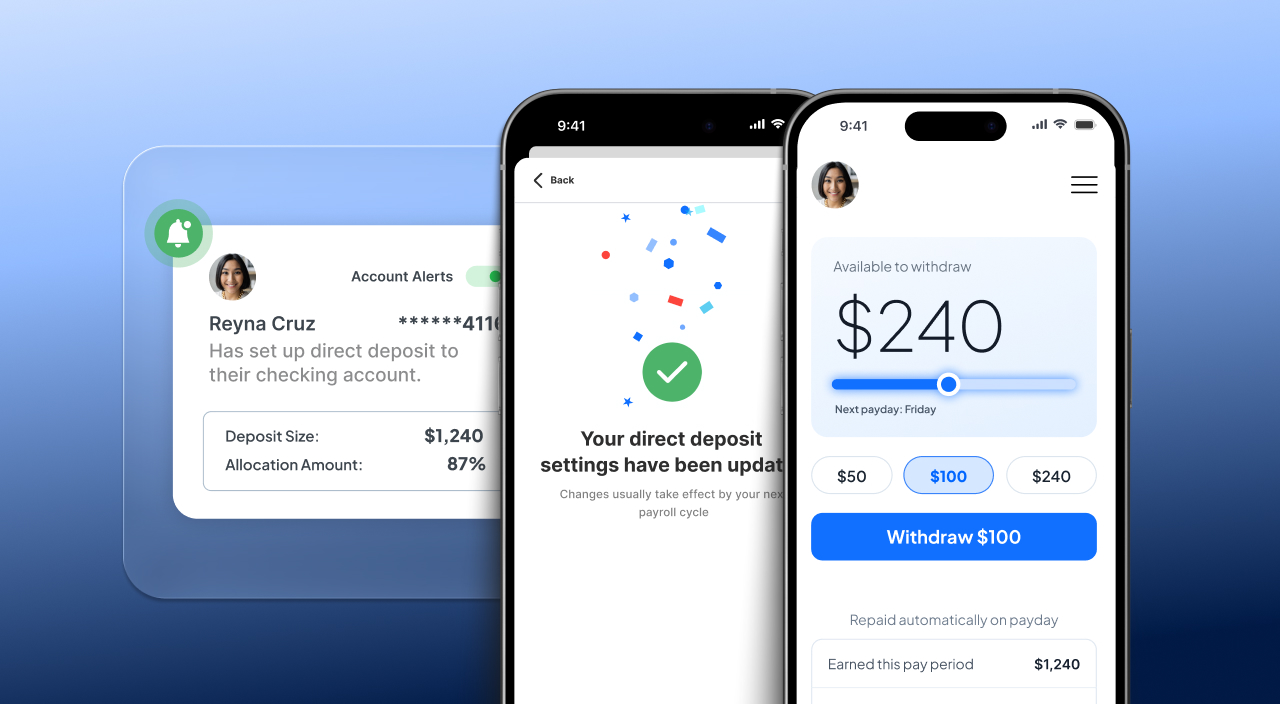
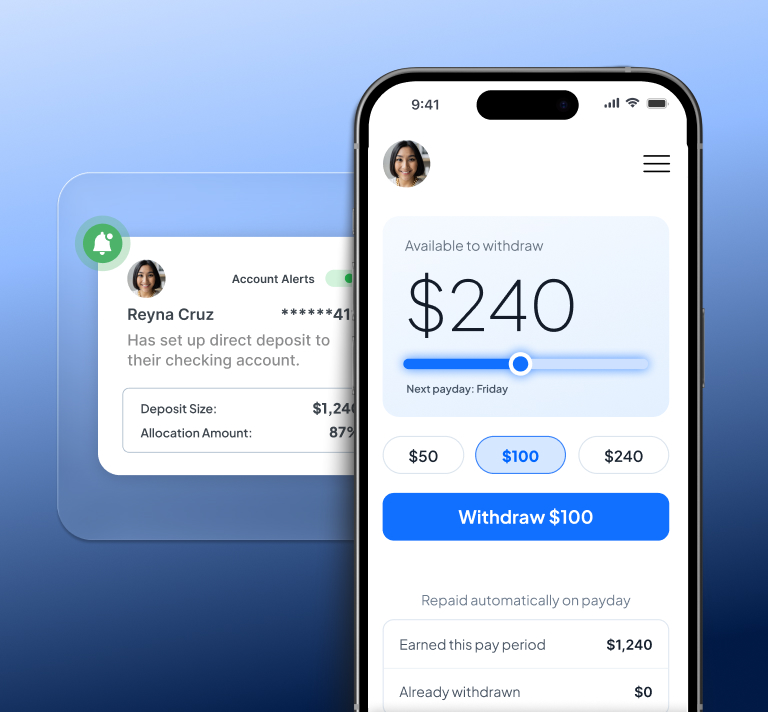
Earned wage access (EWA) lets employees withdraw money they have already earned in advance of payday. It is a benefit that helps ease short-term cash flow needs, which is common among employed Americans. A recent survey by U.S. News & World Report found that 43% of Americans do not have enough savings to pay for a $1,000 emergency expense.
What’s the difference between EWA, payday loans & salary advances?
EWA is often confused with payday loans and salary advances. The differences come down to what the money is, who bears the risk, and how it is repaid.
How does earned wage access work?
EWA works by calculating a worker's accrued pay, advancing a portion of it, and recovering that amount automatically when the paycheck arrives. The typical flow has six steps:
- Enrollment and verification. The worker signs up, passes identity checks, and links a bank account or debit card.
- Data sync. The provider pulls hours worked, pay rate, and deductions from the employer's payroll or time-and-attendance system.
- Available balance. The engine estimates net earned wages to date and applies a cap, commonly a percentage of accrued net pay.
- Withdrawal request. The worker requests an amount in the app. Eligibility, limits, and fraud checks run in real time.
- Disbursement. Funds move to the worker's account, either by standard ACH (often free) or an instant rail for a fee.
- Repayment. On payday, the advanced amount is deducted from the paycheck or debited from the worker's account, and the ledger is reconciled.
What infrastructure does it take to offer earned wage access?
Offering EWA takes eight infrastructure layers, the hardest of which are earnings data and funding. Each layer below answers a separate question: what has the worker earned, can we safely advance it, how does the money move, and how do we get it back.
1. Payroll and time-and-attendance connectivity
EWA is only as accurate as its earnings data, and payroll systems don't inherently surface net earned wages in real time. Providers connect to payroll systems (HRIS, payroll processors, timekeeping tools) through direct APIs, aggregators, or file-based feeds such as SFTP. The key requirements are near-real-time hours and rate data, handling of shift differentials, overtime, tips, and retroactive adjustments, and a fallback when an employer's system has no API.
2. Earned-wage calculation engine
This engine turns gross hours into a safe advanceable balance. It estimates net pay by modeling taxes, benefits, garnishments, and other deductions, then applies a configurable cap, commonly a share of accrued net pay. Caps tend to be conservative because pay is volatile: Pinwheel cites week-to-week swings of about 32% for the average hourly worker, a vendor figure (Pinwheel). The engine must also handle pay-period boundaries, mid-period rate changes, and terminations.
3. Funding and liquidity
Someone has to front the cash between withdrawal and payday. Options include the provider's balance sheet, a warehouse credit facility, forward-flow or receivables financing from institutional investors, or the employer funding advances directly. Because advances are short-duration and repaid within days or weeks, liquidity planning centers on peak demand (such as the days before payday and holidays) and on settlement timing.
4. Payment rails and disbursement
Fast money movement is the user-facing product. Providers typically support ACH for low-cost standard transfers and push-to-debit over card networks (for example Visa Direct or Mastercard Send) or RTP/FedNow for instant delivery. This layer needs sponsor bank or BaaS relationships, bank account and debit-card verification, return and failure handling, and account-ownership checks.
5. Risk, eligibility, and fraud controls
Even in no-recourse models, providers manage loss. Core controls include identity verification (KYC), account-ownership and device checks, velocity and amount limits, employment-status monitoring, and fraud scoring on bank-linking and withdrawals. Models are usually tuned on payroll data rather than credit bureau data.
6. Ledger, reconciliation, and settlement
A double-entry ledger tracks each advance from request through disbursement to recovery. It must reconcile against bank settlements, payroll remittances, and payment-network reports, flag shortfalls when pay is lower than expected, and support audit trails and regulatory reporting.
7. Repayment and recovery
There are two main mechanisms. In payroll-deduction models, the employer withholds the advance from the paycheck and remits it to the provider, which gives high recovery rates but requires deep employer integration. In bank-debit models, the provider debits the worker's account after payday, which works without employer integration but adds return risk and a need for retry logic. A third option is to require that the worker's direct deposit be routed to the provider's account, and vendors such as Pinwheel offer tooling to confirm that routing and alert on changes (Pinwheel).
8. Compliance and data security
This layer covers licensing analysis, disclosures and fee transparency, KYC/AML and sanctions screening, privacy and data-protection controls, and security standards such as SOC 2 and PCI DSS where card data is touched. Wage and bank data are sensitive, so encryption, access controls, and vendor risk management are baseline requirements.
Consumer experience on top
The app or embedded experience sits above these layers: onboarding, a clear available-balance display, upfront fee disclosure, transfer-speed options, and notifications. Employer-facing tools, such as a dashboard for enrollment, funding, and reporting, are part of the same surface.
Where does Pinwheel fit into an earned wage access solution stack?
Pinwheel supplies payroll data for EWA, covering eligibility checks, advance-limit inputs, and repayment monitoring, rather than funding or disbursement. Pinwheel's earned wage access solution page describes three core capabilities, and it states that Pinwheel does not calculate advance limits on behalf of its customers. Payroll systems don’t surface net earned wages in real time, so providers often estimate them. Pinwheel closes that gap by supplying earnings data straight from payroll.
Banks and fintechs using Pinwheel still need to supply their own funding, disbursement rails, a risk and fraud model, a ledger, and a compliance program.
Employer-integrated vs. direct-to-consumer EWA: how the infrastructure differs
Employer-integrated EWA needs deep payroll connectivity, while direct-to-consumer (DTC) EWA needs stronger risk and bank-data tooling. The business model changes which layers carry the most weight.
A third path is growing: embedded EWA, where payroll providers, HR platforms, and banks add EWA as a feature on top of systems they already run. That model shortens integration time because earnings data and the repayment path already exist.
Should you build, buy, or partner for earned wage access?
Most companies should buy or partner unless EWA is their core product, because payroll integrations and funding are slow and costly to build. Build only when you own the data and the customer relationship and need full control of the experience.
As you evaluate how to best structure your EWA offering, questions that will help you settle on an approach include:
- Who owns the worker relationship and the brand?
- Who funds advances, and who absorbs losses?
- How many payroll systems must be covered at launch?
- Is a license or registration required in the states where you will operate?
How is earned wage access regulated?
The rules governing this financial product are still evolving at both the federal and state levels. The central question is whether an EWA advance counts as “credit” under the Truth in Lending Act (TILA) and state lending laws.
- Federal agency view. On Dec. 23, 2025, the CFPB issued an advisory opinion stating that "covered" EWA is not credit under Regulation Z and that optional expedited-delivery fees and voluntary tips are not normally finance charges. It also withdrew a July 2024 proposed rule that would have treated most EWA as credit (Goodwin, Banking Dive). Unlike the 2020 opinion, which covered only employer-partnered EWA, the new one is broader, but it leaves open the status of products outside "covered" EWA (Davis Wright Tremaine). Several federal courts had held certain EWA programs to be credit, largely relying on the withdrawn 2024 proposal.
- Federal legislation. H.R. 9330, the Earned Wage Access Consumer Protection Act, was introduced June 18, 2026 and advanced out of the House Financial Services Committee on June 30 by a 29–22 vote (Faegre Drinker). As summarized by Orrick, it would require a no-cost option whenever a fee is offered and bar late fees, interest, collection suits, and credit reporting of EWA activity. As of mid-August 2026 it had not received a House floor vote (Thomson Reuters), and some members objected that it would limit states' ability to apply their own laws (Consumer Finance Monitor).
- State. By mid-2025, Arkansas, Utah, Kansas, Missouri, Nevada, South Carolina, Wisconsin, Indiana, and Maryland had enacted EWA-specific laws (McGuireWoods), and Louisiana has since done so (ABA Business Lawyer). One 2026 summary counts roughly a dozen states (Beancount). Approaches differ: Indiana requires licensing, Utah requires registration and bans credit checks and debt collection, and Arkansas and Louisiana do not require licenses (Venable, ABA Business Lawyer).
- Practical implications. Design for the strictest likely rules: clear fee disclosure, no required tips, a no-cost standard option, no credit reporting, and no collection actions against workers.
Key takeaways
Earned wage access is a data, funding, and payments problem more than an app problem. Accurate earnings data and reliable repayment decide whether the product is safe to scale, and a clear compliance posture decides whether it can launch at all.
- Start with the earnings data source, since it sets accuracy, risk, and which repayment model you can use.
- Match your funding model to your balance sheet and your tolerance for losses.
- Treat compliance as a design input, not a final check.
- Buy or partner for speed unless EWA is the core of your business.
Teams that get these four decisions right can enhance their customer experience with a compliant, fast and valuable EWA offering that helps employed customers better manage their financial lives.